Why Stripe Froze Your Account (And How to Never Let It Happen Again)
with Rey Pasinli
Ready to make a bigger impact?
Take our free assessment and find your path forward.
About this episode
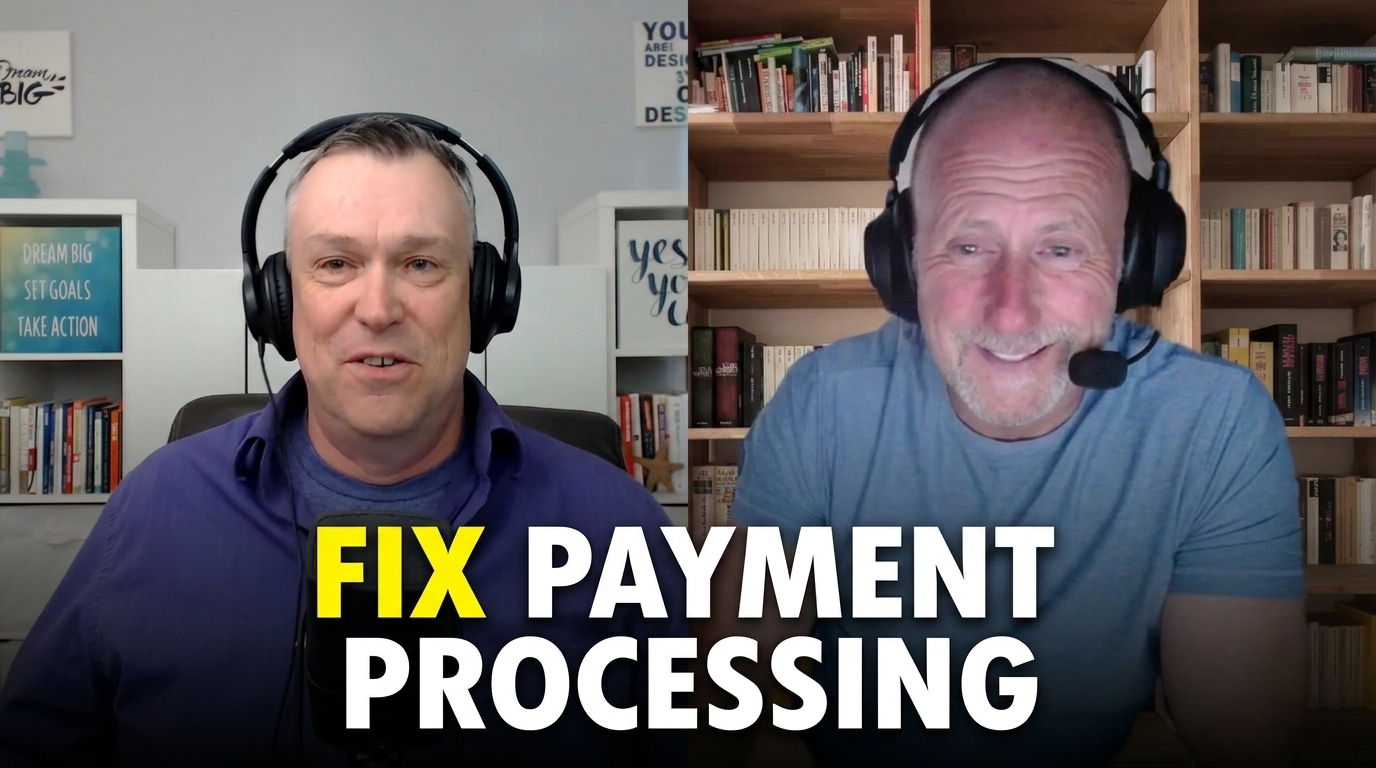
Questions this episode answers
Why did Stripe freeze my account and hold my money?
Stripe's automated algorithm flags accounts that spike outside normal patterns — large transactions, sudden volume increases, or high refund and chargeback ratios. When triggered, your account is frozen and funds held while you attempt to resolve the issue, often with a chatbot rather than a real person.
What is considered a high-risk merchant account in payment processing?
High-risk accounts typically involve large ticket sizes (over $500), continuity or subscription billing, coaching or consulting services, or businesses with revenue spikes from live events or webinars. Less than 10% of all merchants fall into this category, but they're the ones most likely to encounter Stripe or PayPal shutdowns.
When should I stop using Stripe and get a traditional merchant account?
Consider switching when you're consistently processing over $25,000/month, selling packages above $500, running subscription billing, or experiencing revenue spikes from launches or webinars. These patterns trigger Stripe's risk algorithm and make a traditional underwritten merchant account far more stable.
What is the difference between Stripe and a traditional merchant account?
Stripe is an aggregated platform — fast to set up but governed by automated AI risk systems with limited human support. A traditional merchant account involves manual underwriting, a real relationship with a bank, and more stability for businesses with higher volume, larger tickets, or non-standard business models.
How do chargebacks affect my payment processing account?
Chargebacks raise your chargeback ratio, which payment processors monitor closely. If your ratio exceeds acceptable thresholds, your account can be flagged, frozen, or terminated. For high-ticket businesses, even a small number of chargebacks can push you into the danger zone quickly.
Can coaches and online course creators get a high-risk merchant account?
Yes. Working with a payment specialist who understands your business model and has relationships with multiple banks gives you access to merchant accounts specifically structured for coaching, consulting, and online education — with far more protection and longevity than Stripe alone.
Is PayPal safer than Stripe for high-ticket coaching businesses?
Not significantly. PayPal operates similarly to Stripe as an aggregated platform with automated risk systems. Both can freeze funds without warning. For businesses processing large-ticket or high-volume sales, a dedicated merchant account provides more reliable, long-term payment infrastructure.
Key insights
"Anything under twenty-five thousand dollars, especially if your transaction sizes are well below five hundred dollars — I call that the safe zone." — Rey Pasinli
"When you start dealing with continuity subscriptions and bigger ticket packages, you're really outside of what Stripe was built for. It'll be much more reliable to be structured in a traditional merchant account." — Rey Pasinli
"I see problems and I can't stop until I fix and solve them. Once you remove friction from the engine, clients typically grow ten, twenty, thirty percent." — Rey Pasinli
"Less than ten percent of clients encounter a problem with Stripe — but less than ten percent of all merchants would be considered high risk or medium risk. The overlap is almost everyone in the coaching space." — Rey Pasinli
About Rey Pasinli
I started my career as a mechanical engineer on the International Space Station program. These days I engineer payments. For 27 years I have worked with more than 85,000 merchants across roughly 250 banks, processors, ISO's, PayFac's, PSP's and wallet solutions, mostly in the places other providers avoid: high-risk and complex e-commerce.
📄 Free Episode Guide
Get the key takeaways, frameworks, and action items from this episode as a free PDF guide.
Enjoyed this episode? Browse all episodes →
About Chuck Anderson
Chuck Anderson is the founder of EventAffiliates.com, helping coaches and consultants fill events and grow revenue through affiliate partnerships instead of ads or cold outreach. He's the creator of PartnerPilot and host of a show on partnership-driven growth.
Affiliate Management Expert